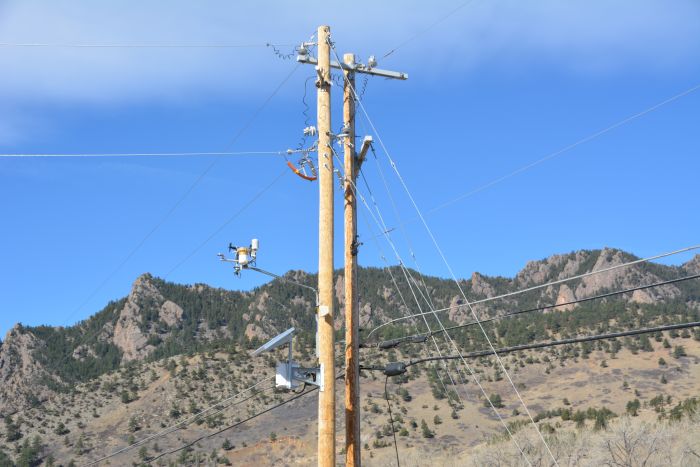
In remote environmental monitoring applications, reliable data transmission is critical. While traditional monitoring stations often rely on terrestrial networks or manual data retrieval, these approaches can lead to costly gaps in critical data, cause delays, and increase operational risk.
To address these issues, Western Weather Group (WWG) and MetOcean Telematics (MetOcean) have joined forces. With the support of Campbell Scientific, they deliver integrated, end-to-end solutions for remote utility weather-monitoring applications.
Each organization plays a critical role:
- WWG leads the weather station design, field deployment strategy, and sensor and connectivity component integration. With multiple station configurations available, WWG ensures installations meet durability, accuracy, and long-term performance standards across critical sectors such as utilities. Their field expertise ensures that every deployment meets rigorous measurement and reliability standards.
- MetOcean provides the global L-band satellite connectivity through the Iridium network, enabled by the direct STREAM+ satellite modem integration with the weather station. This approach provides low-latency transmission and secure, reliable remote weather data delivery to end-user platforms.
- Campbell Scientific supplies the powerful CR1000Xe Measurement and Control Datalogger, which provides reliable sensor integration, intelligent power management, and long-term autonomous operations. Known for performance in even the most extreme conditions, the CR1000Xe serves as the system's operational backbone.
Instead of requiring end users to assemble separate components on their own, this partnership provides a fully integrated weather-monitoring solution—one designed, built, and supported as a single, cohesive ecosystem.
Deployment Update: Scaling across the Southwestern U.S.
The collaboration’s positive impact has grown significantly. With approximately 700 deployments across the Southwestern U.S., the deployment supports wildfire response and utility-sector applications in high-risk areas.
The Power of Collaboration
The success of this initiative is rooted in its deep technical collaboration. WWG, MetOcean, and Campbell Scientific worked closely together to fully integrate their components, thereby achieving seamless inter-device communications between Campbell Scientific’s CR1000Xe datalogger and MetOcean’s Iridium satellite modem. Paired with WWG’s installation, deployment strategy, and integration, the solution represents a collaborative approach to ensuring reliable, end-to-end data transmission—even in the most remote locations.
A Focus on the Future
With nearly 700 active units deployed and momentum accelerating, this collaboration demonstrates how integrated satellite connectivity can transform remote weather data collection. As adoption continues to grow, the cooperation between MetOcean, WWG, and Campbell Scientific remains focused on long-term operational resilience and scalable performance.
Together, we are addressing a connectivity gap and redefining what reliable remote monitoring looks like.
Case Study Summary
Application
Addressing connectivity gaps and redefining reliable remote monitoringLocation
Southwestern United StatesProducts Used
CR1000XeParticipating Organizations
MetOcean TelematicsRelated Website
MetOcean Telematics website Western Weather Group websiteParticipating Consultants/Integrators
Western Weather Group, Inc.View the PDF