In Nicaragua, hydroelectric power is more than infrastructure. It’s a cornerstone of the country’s energy future. Ensuring these systems operate safely and efficiently is critical, not only for energy production but also for the communities that depend on them.
Recently, a landmark project transformed how three major dams are monitored. What began as a technical challenge became a major step forward for the nation’s energy infrastructure.
A Vision Led by ENEL
The Nicaraguan Electricity Company (ENEL) has long prioritized renewable energy as a pathway to sustainable development. Hydroelectric generation plays a central role in that vision, supported by key assets such as the Mancotal, El Dorado, and El Salto dams.
Previously, these dams shared a critical limitation: their monitoring systems were either outdated or no longer operational, leaving gaps in the data needed to assess structural performance. For decades, there was limited visibility into how these structures would respond to extreme conditions, including seismic activity or major floods.
For ENEL, this went beyond a technical challenge. As a provider of national energy, ensuring the safety and reliability of this infrastructure is essential. Without reliable monitoring, it was difficult to take preventive action or issue early warnings, increasing risks for both the dams and the communities downstream.
To improve visibility and reduce uncertainty, ENEL initiated a project implementing real-time monitoring across its infrastructure. To bring this vision to life, they partnered with Construcciones Lacayo Fiallos (CLF) and worked with multiple organizations, including Campbell Scientific, to deliver the technology and expertise required.
From Limited Visibility to Real-Time Insight
The team faced a complex challenge: designing and implementing a system capable of continuously monitoring dam conditions and delivering data in real time.
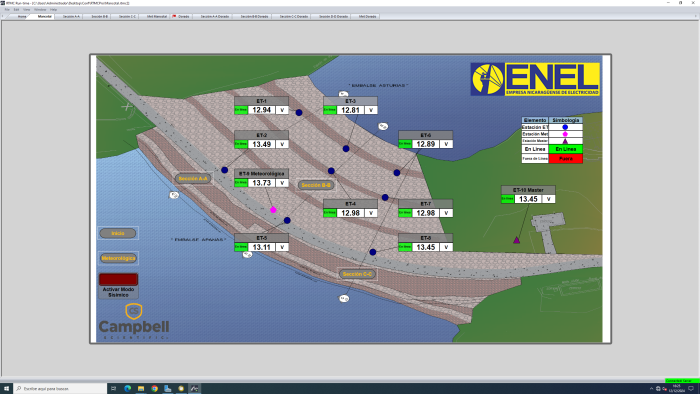
They built a solution that combined geotechnical instrumentation, wireless communications, and centralized data visualization. The system streams data seamlessly from the field to ENEL’s control centers through a fiber optic network, allowing operators to monitor key variables instantly.
For the first time, engineers can now observe how the dams behave as conditions change.
A First-of-Its-Kind Implementation
This is believed to be the first Nicaraguan project to deliver a fully automated, real-time monitoring and visualization system for dams. That distinction marks a major milestone. For ENEL, this signifies a shift in how infrastructure is managed. Instead of relying on limited or delayed data, teams can now identify trends, detect anomalies, and respond proactively.
Overcoming Challenges Together
The timeline was ambitious, with only a year and a half planned to complete this job. Delivering a project of this scale required strong coordination and adaptability across teams. While initially planned for a longer duration, the team completed the project in just eleven months—despite early delays in equipment importation and the introduction of new technologies. In addition, there were challenging field conditions, including limited geotechnical information, which made drilling for piezometer installation more difficult than expected.
Collaboration across teams proved essential while managing these complexities. Engineers from CLF worked alongside Campbell Scientific specialists to address technical challenges, refine installation processes, and ensure system reliability.
As the project progressed, these collaborations evolved into an efficient and well-coordinated workflow that kept the project on track.
A Collaborative Effort
Multiple organizations collaborated, each contributing specialized expertise in design, construction, and monitoring. Together, they worked toward a shared goal of modernizing dam infrastructure in Nicaragua.
Because reliability was a top priority throughout the project, ENEL and its partners chose to use Campbell Scientific to deliver the data acquisition, communications, and visualization systems equipment. This equipment—well known for its reliability and long-term performance—included the CR6 High-Capacity Data Acquisition System, VWAnalyzer Vibrating Wire Analyzer, CRVW3 Vibrating Wire Node, and Real-Time Monitoring and Control Software. Campbell Scientific's proven track record, combined with a strong focus on accurate measurement, helped ensure the solution’s success in a setting where having dependable data is essential.
Real Impact, Real Results
Since the monitoring system's implementation, ENEL has gained a new level of visibility and control. The system delivers continuous, real-time data with reliable communication across all monitoring points. This has improved operational efficiency and strengthened decision-making.
Key benefits include:
- Faster identification of potential risks
- Greater safety for downstream communities
- Stronger long-term asset management
- Quicker response time to changing conditions
With support from Campbell Scientific’s technology, ENEL now has the tools needed to monitor and manage its dams with confidence.
Future Outlook
This project sets a new standard for infrastructure monitoring in Nicaragua. It also creates opportunities for expanding similar systems to other hydroelectric and geothermal facilities.
- For ENEL, the project represents a meaningful step toward a more modern, resilient energy system.
- For Campbell Scientific, the project reflects a continued commitment to supporting partners with reliable measurement solutions that enable better decisions and safer operations.
Together, the collaboration demonstrates what is possible when strong vision meets the right technology.
Do you have a project that needs updating or improvement? Reach out to our sales team at infra-sales-na@campbellsci.com. We’d love to help you find a solution that best suits your project and budget.
Case Study Summary
Application
Hydroelectric power monitoringLocation
NicaraguaProducts Used
RTMC VWAnalyzer CRVW3 CR6Participating Organizations
Nicaraguan Electricity Company (ENEL), Construcciones Lacayo Fiallos (CLF)View the PDF